


Breast Augmentation
in Grand Rapids, MI
Augmentation mammoplasty, commonly known as breast augmentation, is a surgical procedure in which implants are used to enlarge and enhance the breasts, for those who desire a more pleasing shape and/or proportions.*
As a patient at the Centre for Plastic Surgery, your breast augmentation procedure will be customized to fit your individual goals and needs. Our expert staff and board-certified plastic surgeons will walk you through your implant options, listen to your concerns, educate you on the procedure, and help you to visualize a result in which you look and feel absolutely incredible!
Why Consider Breast Augmentation Surgery?
Most patients seeking breast augmentation surgery just want to feel good in their own skin. It’s not unusual for breasts to change as we mature, particularly following child birth, so for some patients it is about restoring a fuller and more youthful looking breast shape. For others, they were never gifted with breasts that made them feel feminine and confident, so breast augmentation offers a chance to feel beautifully balanced. Breast augmentation on its own cannot correct severe ptsosis (sagging). This would require a breast lift. What it can do is:
- Increase the size of your breasts
- Create a fuller and more shapely breast appearance
- Correct breast asymmetry
What to expect with Breast Augmentation
At the Centre for Plastic Surgery, we want you to be comfortable and prepared for your breast augmentation procedure. Our all-inclusive approach means that your surgery will include your implants, anesthesia, the facility, appointments, and garments. During your initial consultation, we’ll be taking photos for your medical record. It may feel slightly awkward, but please know that this is an important part of your care. We’ll do everything possible to make you feel at ease. In this appointment, we’ll be discussing the type of implant, the implant placement, and incision type best suited to meet your goals. Your options are as follows:
Breast Implants
Choose from a full catalog of American-made Mentor® saline and silicone implants, as well as Motiva® silicone implants. Saline implants have an outer silicone shell but are filled with a saline solution. Modern FDA-Approved Silicone Gel implants have a silicone shell but are filled with a cohesive silicone gel. Our team will help you to navigate the implant type that best fits your aesthetic goals.
Breast Implant Placement
Many implant placement options exist, each with its own benefits. As a rule, the deeper the implant is placed inside your body, the more natural looking your breasts will be. The two most known are:
- Submuscular (most common): In this placement technique, the muscle is dissected and the implant is positioned behind the chest wall muscle.
- Subglandular: In this placement technique, the implant is positioned behind the glandular tissue of the breast.
Breast Augmentation Incisions
Like placement type, the incision depends on many factors, and your surgeon will guide you to the best option for you. The three main incisions used are:
- Inframammary Fold (most common): This incision is made under the natural fold on the under side of the breast
- Axillary: The incision is made in the underarm.
- Periareolar: This incision is made around the areolas.
Once your breast augmentation is scheduled, we’ll arrange for your pre-operative appointment. During this visit you’ll be finalizing the details of your surgery, preparing for recovery, and meeting again with your surgeon. The procedure will take place in office in our fully accredited outpatient facility under general anesthesia administered by our board-certified anesthesiologists.
What to Expect During Your Recovery from Breast Augmentation Surgery
Recovery from Breast Augmentation is different for everyone, but the majority of our patients experience minimal pain and return to most of their normal daily activities within a week or two of the procedure. You’ll likely feel pretty sleepy immediately after your surgery as a result of the anesthesia, and need some prescribed pain medication for at least the first few days. It’s important that you have a trusted caregiver with you on the day of surgery who will stay with you for at least the first 24- 48 hours after your procedure. We’ll be monitoring your progress with post-operative appointments, but we are also available to answer questions or concerns that may arise at anytime.
For the months following your breast augmentation, your implants will sit higher and tighter on your chest as the muscle begins to relax around the implant. You may also be experiencing swelling during this time that will affect the look of your breasts. A great rule of thumb is to expect your final result to become apparent around the six month mark.
The Ideal Candidate for Breast Augmentation Surgery
Ideal candidates for breast augmentation surgery are adults who are physically and mentally healthy enough to undergo this type of elective surgery. Those who are most fulfilled with their outcomes have sensible expectations and a decent understanding of their own anatomy.
Breast Augmentation in Grand Rapids, MI
Before & After
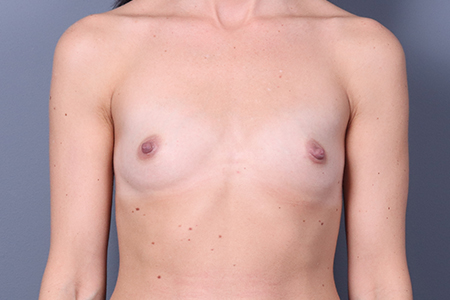
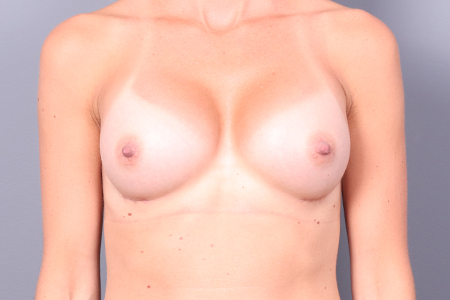
Breast Augmentation Patient 118
This patient is a healthy 30 year old woman (5’2”, 109 pounds) who desired larger breasts, and specifically wished for more upper breast fullness. She underwent a submuscular breast augmentation using 400cc smooth round moderate plus implants through an inframammary crease. She went from an A cup to a natural looking C cup. She was very happy with the final outcome of her procedure. The after photos were taken six months after her breast augmentation procedure.
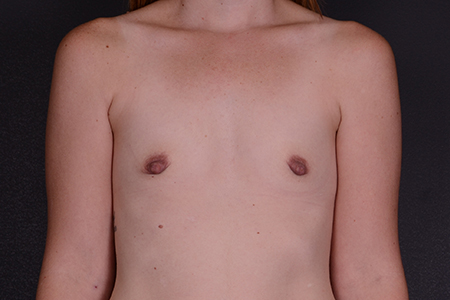
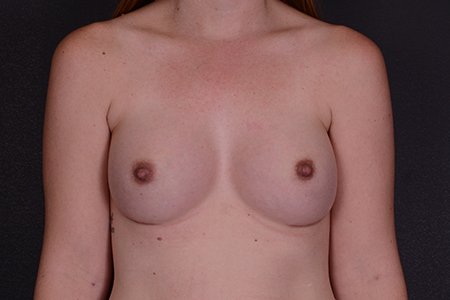
Breast Augmentation Patient 84
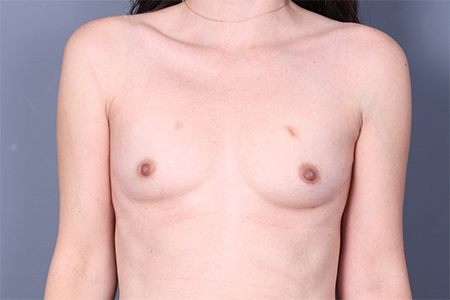
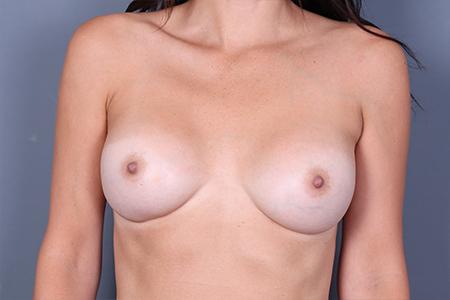
This patient is a healthy 26 year old woman (5’4", 125 pounds) who was unhappy with her natural breast size. She underwent a bilateral breast augmentation through inframammary incision using Mentor smooth, round, high profile 375 cc memory gel implants placed in the sub-muscular position. Her scar is slightly visible in these three months post-op photos due to the small amount of breast tissue she has to start with. She went from a small A cup bra size to a C cup bra size.
Breast Augmentation Patient 172
This is an active 47 year old woman (5'7", 121 pounds) who was dissatisfied with the size of her breasts and desired larger breasts while maintaining a natural appearance. She underwent a bilateral submuscular breast augmentation with an inframammary incision using Mentor Smooth Round Moderate + Memory Gel implants with a volume of 350cc on the left and 375cc on the right. She returned to full activity after her recovery period and is very satisfied with her final results. The after photos were taken three months after her breast augmentation procedure.
How Much Does Breast Augmentation Surgery Cost?
The cost of breast augmentation surgery depends on the type of implant used, and the scope of the procedure(s) you may need to achieve your desired outcome.
We recommend a contact the office for the most accurate estimate. However, if you’d like a general idea of the cost, you can visit our online pricing estimator.
We Offer Financing
At the Centre for Plastic Surgery we understand that investing in yourself is a big decision. If financing is a concern, we are happy to help by guiding you to trusted partners with experience in medical lending.
FAQs
Frequently Asked Questions About Breast Augmentation
How do I choose the right breast implant size and shape?
This is one of the most exciting parts of planning! Start by saving a few wish photos of results you love, ideally from patients whose starting shape is similar to yours. Our breast augmentation before-and-after gallery and the Mentor website are great places to look. At your consultation, your surgeon will take measurements and use sizing tools so you can see what your result could look like. There’s no rush, and no question is too small.
Should I choose saline or silicone implants?
Both are excellent options, and both have a silicone outer shell. Saline implants are filled with sterile salt water, while silicone implants are filled with a cohesive gel that many patients love for its natural look and feel. The FDA approves saline implants for cosmetic augmentation at age 18 and older, and silicone implants at age 22 and older. We offer a full range of saline and silicone implants from trusted manufacturers like Mentor and Motiva. At your consultation, we’ll walk you through every option and help you choose the implant that best fits your short- and long-term goals.
Is breast augmentation safe?
Breast augmentation is one of the most common and well-studied cosmetic procedures, and the implants we use are FDA-approved. Like any surgery, it does carry some risks, and we’ll walk you through every one. You’ll be in great hands: a board-certified plastic surgeon performs your procedure in our accredited outpatient facility, with anesthesia provided by board-certified anesthesiologists.
What are the risks of breast augmentation?
We believe informed patients make the best decisions, so here’s an honest look. Risks include complications from anesthesia, bleeding, infection, capsular contracture (scar tissue tightening around the implant), implant leak or rupture, changes in nipple or breast sensation, asymmetry, and the possible need for more surgery. We’ll go over each one with you before surgery, along with the FDA-required patient decision checklist, so you feel confident and prepared.
What is recovery like after breast augmentation?
Good news: most patients are back to their normal daily activities within one to two weeks. On surgery day you’ll likely feel sleepy, and you’ll need prescription pain medication for the first few days. Plan to have a trusted adult stay with you for the first 24 to 48 hours. Your surgeon will let you know when you’re cleared for exercise and heavy lifting. Your implants will sit high at first and settle into place over the following months, with your final result showing around six months.
How much does breast augmenation cost?
Your cost depends on the implant type and whether you pair augmentation with other procedures. We keep things simple with all-inclusive pricing that covers your implants, anesthesia, facility fees, follow-up appointments and surgical garments. Try our pricing estimator for a ballpark figure, or reach out for an exact quote. Monthly payment plans are available, too!
Can I breastfeed after breast augmentation?
In most cases, yes! An incision under the breast fold or in the armpit avoids cutting through milk ducts, and placing the implant under the muscle keeps it away from the glandular tissue. An incision around the areola carries a somewhat higher chance of affecting milk supply or nipple sensation. If breastfeeding is in your future, let your surgeon know so it can be part of your plan.
Will breast augmentation lift sagging breasts?
Implants are great at adding volume and fullness, but they can’t correct significant sagging (ptosis) on their own. If your nipples sit at or below the breast fold, a breast lift may be the missing piece, and it can often be done at the same time as your augmentation.
How long do breast implants last?
Breast implants aren’t lifetime devices, so it’s smart to plan ahead. Many patients have them removed or replaced at some point, often for cosmetic reasons as their bodies change. Others need surgery to treat a complication such as capsular contracture or rupture. The longer you have implants, the more likely you are to need another procedure, and we’re here for you whenever that time comes.
Do I need imaging to check silicone implants for rupture?
Yes, and it’s an easy step to stay on top of. The FDA recommends that patients with silicone implants have an ultrasound or MRI 5 to 6 years after surgery and every 2 to 3 years after that, even without symptoms. Keep up with routine mammograms as recommended for your age, and let your technician know you have implants. If you’re ever concerned about a rupture, contact us and we’ll help you arrange an ultrasound or MRI.
Do you offer a warranty on breast implants?
Yes! Both of our implant partners, Mentor and Motiva, offer a product warranty, with options to extend your coverage. Terms vary by manufacturer and implant, so check Mentor’s warranty page and Motiva’s US website for current details. We’re always happy to explain how it applies to your implants.
What is breast implant illness (BII)?
Some patients with implants report symptoms such as fatigue, joint pain or difficulty concentrating that they attribute to their implants, known as breast implant illness. The FDA and researchers continue to study it, but no test can diagnose it and a direct cause has not been established. If you ever have concerns or notice new symptoms, please reach out. We’re always glad to talk it through with you.
Do breast implants cause cancer?
Breast implant-associated anaplastic large cell lymphoma (BIA-ALCL) is a rare cancer of the immune system linked mainly to textured implants, which we don’t use. Warning signs include new swelling, a lump or pain around the implant, usually years after surgery. The FDA does not recommend removing implants in patients without symptoms. Rare cancers in the scar capsule around implants have also been reported, so keep up with your follow-up visits and let us know about any changes. We’re here for you every step of the way.